Description
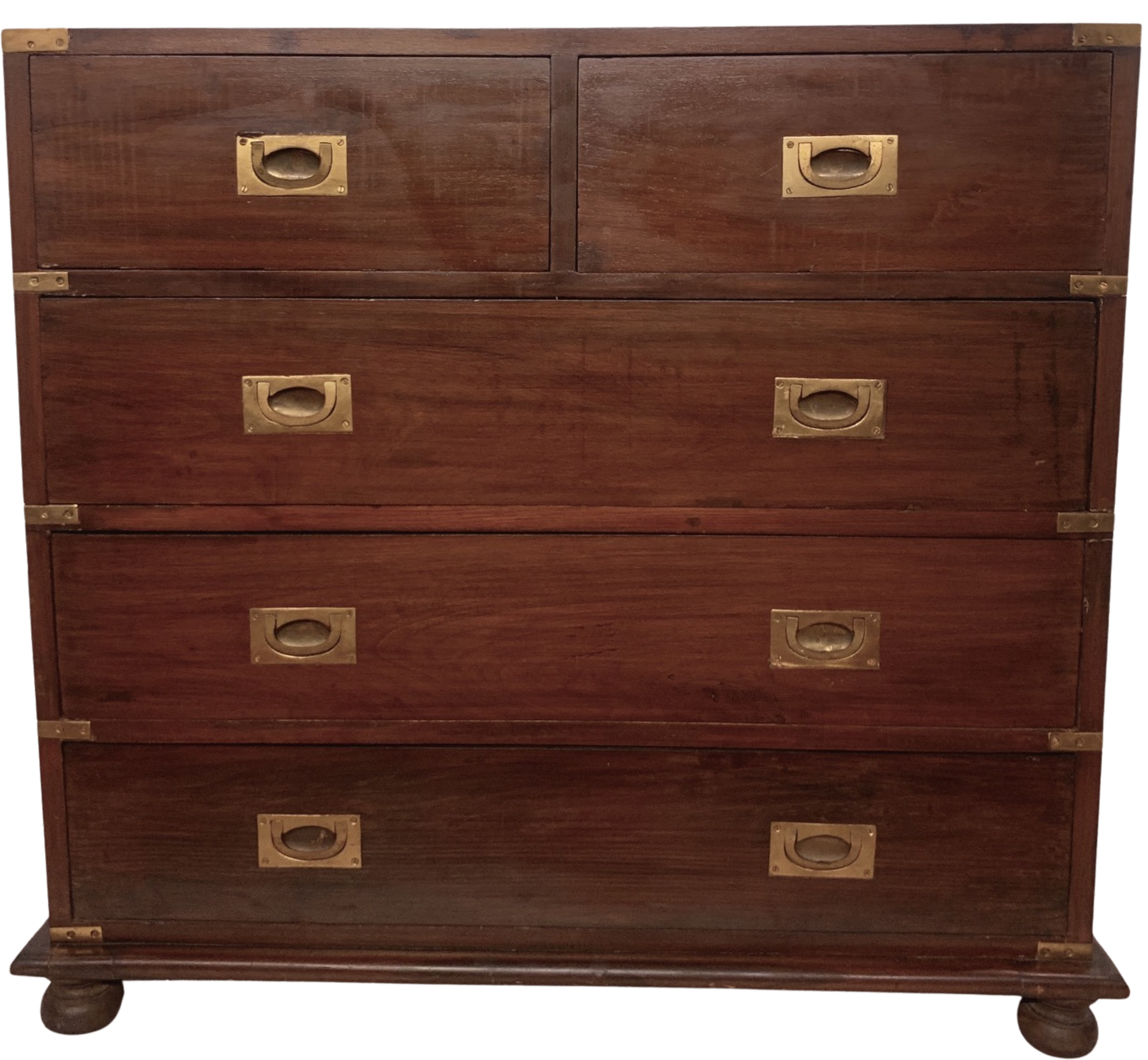
This 19th-century British campaign chest is made of hardwood, like mahogany. It was acquired in Kolkata (formerly Calcutta) which was India’s capital under the British Raj from 1773 to 1911.
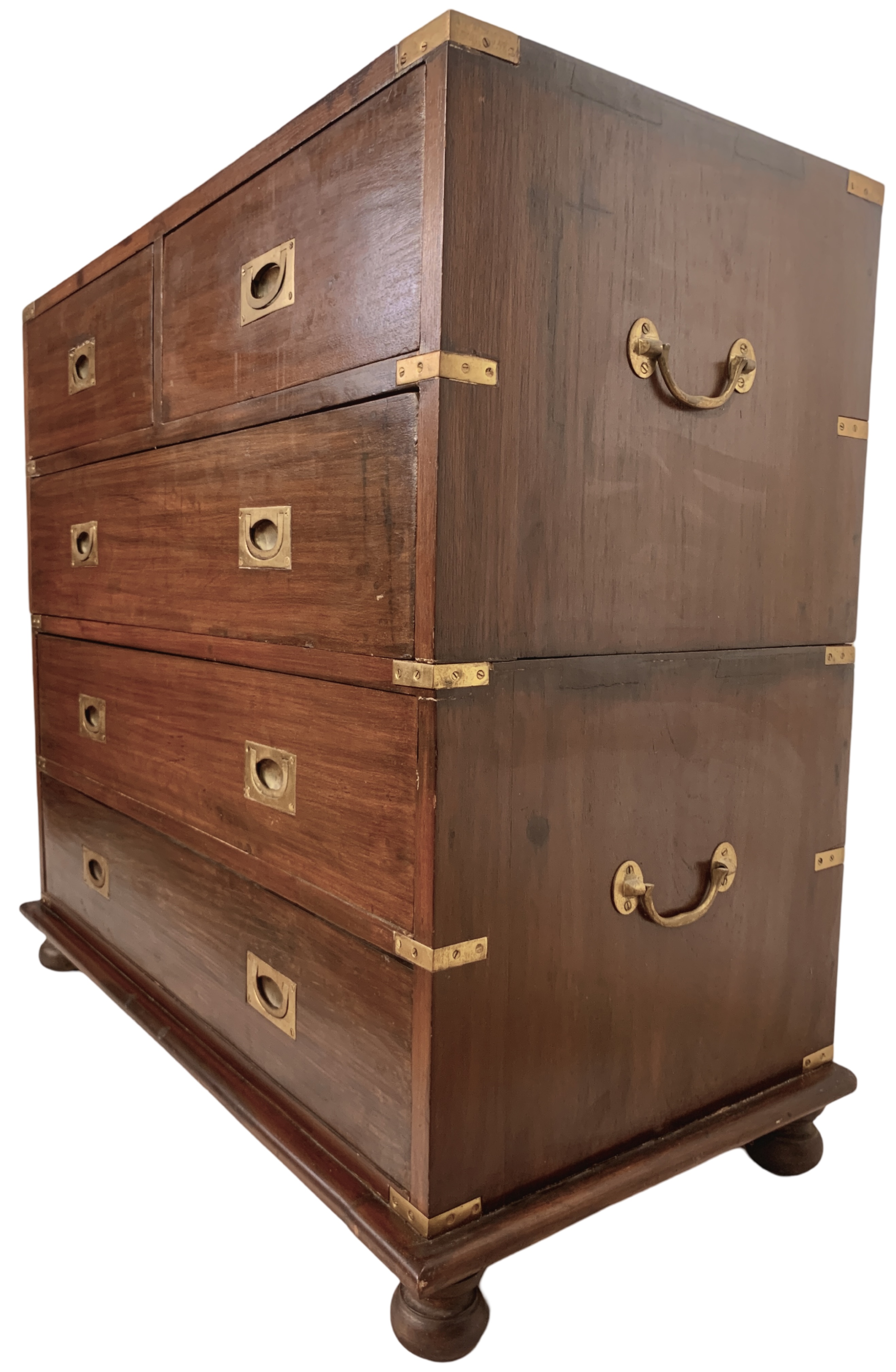
As typical of campaign furniture, this chest of drawers separates into 2 pieces for easy transport. It features hand-forged brass handles on the sides to aid carrying and as well as brass corner strappings.
The chest stands on bun-feet and is fitted with 5 drawers. The drawers feature recessed pull tabs with hand forged brass handles.
This piece embodies the functional elegance and fine craftsmanship associated with campaign furniture. The chest’s modular design make it suitable for travel and transport with pack animals.
The British Campaign Chest in Colonial India: Craftsmanship, Functionality, and Cultural Exchange in the 19th Century
The British campaign chest is a quintessential artefact of colonial history, embodying the demands of a mobile, military-oriented lifestyle while exemplifying craftsmanship suited for both durability and elegance. Originating from a need for functional, transportable furniture in the late 18th century, campaign chests and other pieces of campaign furniture evolved to serve British officers on military expeditions across the globe.
By the 19th century, the campaign chest had become an emblem of British Colonial lifestyle with officers stationed for extended periods relying on well-crafted, easily movable furniture to maintain a semblance of English domesticity.
In examining this campaign chest, we can trace the evolution of campaign furniture as well as its craftsmanship and production context. Drawing from works by Nicholas A. Brawer, Amin Jaffer, and T.J. Barringer, we will explore the cultural and functional significance of campaign furniture, considering the historical, aesthetic, and cross-cultural dimensions that make it a hallmark of British colonial life.
Origins and Development of Campaign Furniture
The origins of campaign furniture trace back to the practical demands of British military campaigns during the 18th century. British officers required furnishings that could be easily dismantled, transported, and reassembled as they moved between various stations and climates. Nicholas A. Brawer explains that the intent was to balance elegance and utility, producing pieces that could endure rugged travel yet maintain an air of refinement suitable for British officers of rank (Brawer, 2001, p. 11).
Campaign furniture encompassed a variety of items—chests, tables, desks and chairs, each designed to fold, collapse, or disassemble. Brawer notes that these pieces were often crafted from durable woods such as mahogany or teak, known for their resilience and ability to withstand fluctuating temperatures and humid conditions (Brawer, 2001, p. 15).
The campaign chest acquired by Dr. Waelde reflects the typical structure of these pieces. Its two-piece design allowed it to be easily separated and transported, while the brass fittings served both decorative and protective purposes. Flush brass handles and brass corner strapping protected the wood from impacts during transit, adding a layer of durability essential for a life on the move.
Campaign Furniture in Colonial India: Craftsmanship and Adaptation
As British military and administrative personnel were stationed throughout the Empire, the production of campaign furniture expanded beyond Britain to regions with a growing presence of British officers and administrators. Indian craftsmen, known for their skill and adaptability, began producing campaign furniture in the British style while incorporating local materials and techniques.
Amin Jaffer observes that Indian workshops, particularly in colonial hubs like Calcutta and Bombay, became skilled in producing furniture that closely adhered to British tastes yet often used indigenous materials better suited to the Indian climate (Jaffer, 2001, p. 78).
Kolkata, became one of the primary centers for the production of campaign furniture in India. While initially copying British designs, many local craftsmen subsequently refined this style, introducing subtle decorative elements influenced by Indian aesthetics, though maintaining the overall simplicity and functionality characteristic.
Barringer’s Imperial Visions notes that campaign furniture, while utilitarian in origin, “began to reflect a convergence of British military order and Indian artistic sensibility,” marking it as an artifact of colonial hybridity (Barringer, 1997, p. 49).
Design and Functionality of the Campaign Chest
The campaign chest is distinguished by its modular design and durable construction, embodying the core principles of portability and functionality. This particular chest’s two-part construction allows for ease of movement, enabling officers to assemble or disassemble it quickly. The brass corner straps and flush handles are both practical and aesthetic, with brass serving as a resilient material resistant to the corrosive effects of humidity and temperature fluctuations.
John Gloag, in A Social History of Furniture Design, describes campaign chests as “epitomes of practicality in the field,” noting that their construction mirrored the disciplined lives of military officers who required every item to serve a purpose, be compact, and support their transient lifestyle (Gloag, 1962, p. 233). The flush handles minimised protrusions, preventing accidental snagging during transport, while side handles allowed for lifting the chest when fully assembled or divided.
Symbolism of the Campaign Chest in British Colonial Life
In The Englishman’s Chair, V. Beattie describes the campaign chest as “a metaphor for the British Empire itself—resilient, adaptable, and ever-moving” (Beattie, 1990, p. 211). The simple, structured design conveyed a sense of order, aligning with the British self-image of disciplined governance over the territories under its rule. In the hands of officers stationed in India, campaign chests represented the British ability to impose domestic order and familiarity even in foreign, often challenging environments.
These chests also symbolized the resilience of British cultural identity, as they allowed officers to maintain an element of “home” within their temporary dwellings. The design’s durability and modularity echoed the British belief in their “civilizing” mission, with campaign furniture becoming a cultural artifact that symbolized stability amid the perceived “chaos” of the colonies (Boehmer, 2005, p. 66).
Campaign Furniture’s Legacy and Influence on Modern Design
Campaign furniture, with its combination of elegance, durability, and modularity, left a lasting impact on furniture design beyond the colonial period. As officers returned to Britain, they brought campaign chests and other furnishings with them, which became collectibles and were integrated into English domestic interiors. The simplicity and functionality of campaign furniture influenced later design movements, particularly during the 20th century. As Gloag describes, campaign furniture’s “form follows function” ethos anticipated elements of modernist design, inspiring designers to create modular, transportable pieces suited to a more transient lifestyle (Gloag, 1962, p. 246).
The campaign chest’s design principles—adaptability, compactness, and understated elegance—continue to inform contemporary furniture. Designers appreciate the clean lines and practicality of campaign furniture, viewing it as a precursor to minimalist aesthetics and a model of functional design. Edward Pinto’s Treen and Other Wooden Bygones of Daily Life argues that the modularity inherent in campaign furniture reflects a pragmatic approach to design that remains relevant in modern homes where versatility and space-saving solutions are essential (Pinto, 1970, p. 89). Pinto notes that the emphasis on portability and multifunctionality in campaign furniture laid the groundwork for modern trends in modular design, as it championed the idea that furniture should adapt to various environments and meet the changing needs of its users.
In contemporary design, campaign furniture is admired not only for its practicality but also for its understated beauty and craftsmanship. The visible brass fittings, simple joinery, and robust hardwoods, often left in their natural finish, showcase a timeless aesthetic that resonates with today’s preference for minimalism and sustainability. Adam Bowett observes that campaign furniture’s straightforward, robust construction mirrors a shift in modern design philosophy that favors durability and eco-conscious materials over ornate embellishments (Bowett, 2002, p. 140).
Moreover, the historical narrative attached to campaign furniture—rooted in adventure, exploration, and the resilience of the British Empire—adds a romantic allure, which continues to captivate antique collectors and designers alike. The symbolic value of these pieces, as Nicholas Brawer highlights, brings a sense of heritage and global connection to modern interiors, blending functionality with a rich story of cross-cultural influences (Brawer, 2001, p. 78). The legacy of campaign furniture thus endures not just as collectible antiques but as a significant influence on contemporary design, celebrating a blend of utility, elegance, and history that remains appealing in modern homes.
Campaign Furniture’s Evolution and Legacy
The legacy of campaign furniture has extended beyond its original military applications, influencing furniture design, manufacturing, and consumer expectations well into the 20th and 21st centuries. As returning British officers introduced campaign chests and other pieces to Britain, these items gradually transitioned from symbols of colonial authority to prized antiques, valued for their practicality and timeless aesthetics. Their unique blend of portability, modularity, and elegance—originally essential for a life of movement—found appeal in modern homes where space efficiency and functionality became desirable qualities. John Gloag points out that the shift from British officers using campaign furniture in far-flung colonies to civilians adopting it in urban settings illustrates the timeless adaptability of such pieces, especially as homes became more compact in industrial cities (Gloag, 1962, p. 252).
Campaign furniture’s functional design was also a precursor to modern modular furniture, with its emphasis on easy assembly, disassembly, and adaptability to different spaces. Many contemporary designers have drawn inspiration from the clean, simple lines and durability that characterize campaign chests and other military furnishings. Bowett suggests that campaign furniture influenced mid-century modern designers, particularly those who valued minimalism and practical design, helping to shape a new appreciation for pieces that embody both aesthetics and utility (Bowett, 2002, p. 126). The enduring appeal of campaign furniture in the antique market today attests to its resilience and timelessness, with pieces like Dr. Waelde’s 19th-century campaign chest remaining highly sought after for their historical significance and elegant functionality.
Conclusions
The British campaign chest, is more than a practical object; it embodies the complex dynamics of British imperialism, craftsmanship, and design. With its two-part structure, brass fittings, and use of mahogany, this chest reflects the requirements of a military lifestyle that valued durability and elegance. Campaign chests like this one were instrumental in helping British officers maintain a semblance of home life even while stationed in foreign territories, symbolizing the British desire to bring “civilized” comforts into what they considered less familiar environments.
As campaign furniture spread across the British Empire and local craftsmen in India adapted to its demands, these items also came to reflect a unique cross-cultural exchange. By blending British and Indian elements, campaign furniture exemplifies the intersection of European and Asian craftsmanship and highlights the economic and cultural complexities of colonial enterprise.
In the postcolonial era, campaign chests have transcended their military origins to become valuable antiques and influential models for modern design. Their enduring appeal lies in their blend of functionality, portability, and restrained elegance, qualities that continue to resonate with modern sensibilities.
Today, campaign chest are valued not only as artefacts of history but also as symbols of adaptability and timeless design. In both their form and cultural legacy, British campaign chests stand as enduring testaments to a period of global movement, military influence, and cross-cultural interaction, offering a unique lens through which to view the material history of the British Empire.
Provenance
- Acquired in Kolkata (formerly Calcutta), India’s capital under the British Raj from 1773 to 1911
- Private Collector (2000’s), acquired in Singapore then subsequently brought to Penang
References
- Brawer, Nicholas A. British Campaign Furniture: Elegance Under Canvas, 1740–1914. New York: Harry N. Abrams, Inc., 2001.
- Barringer, T.J. Imperial Visions: The Art of the British Empire. Manchester University Press, 1997.
- Bowett, Adam. British Furniture 1600–2000: An Illustrated History. Antique Collectors Club, 2002.
- Gloag, John. A Social History of Furniture Design. George Allen & Unwin, 1962.
- Jaffer, Amin. The Furniture of British India and Ceylon: 1600–1900. V&A Publications, 2001.
- Beattie, V. The Englishman’s Chair: Origins, Design, and Social History. Thames & Hudson, 1990.
- Pinto, Edward. Treen and Other Wooden Bygones of Daily Life. Bell & Hyman, 1970.
- Boehmer, Elleke. Colonial and Postcolonial Histories: Literature, Politics, and Culture. Routledge, 2005.
 The Gallerist Company